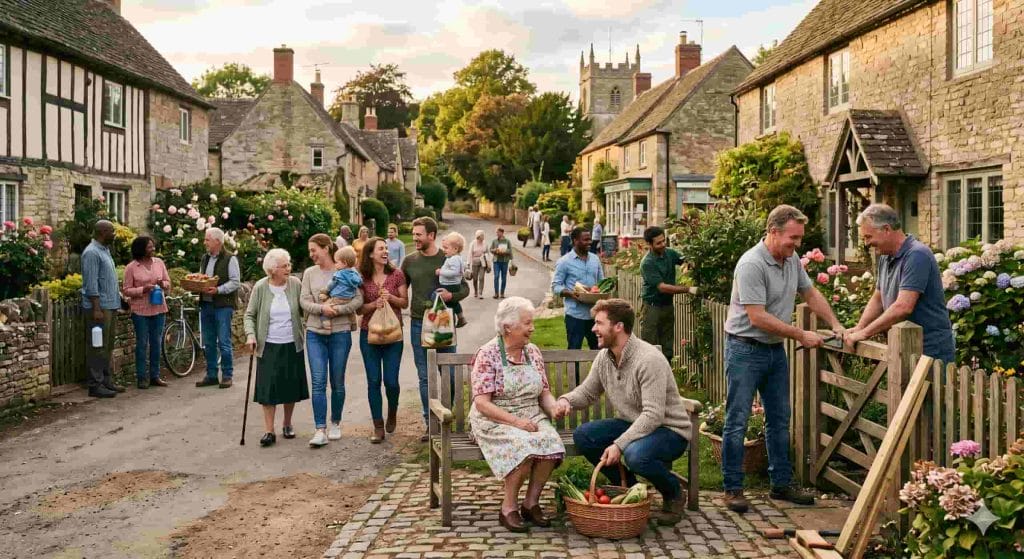
Social capital has been collapsing across the Western world for fifty years. The consequences — for health, trust, productivity, and the fabric of democracy — are now measurable. Rebuilding it will require a different conversation with communities.
The choirs that built democracies
Harvard political scientist Robert Putnam made the observation of his career while working in post-war Italy. Choirs, he discovered, were consistently associated with communities that thrived under Italy’s new democratic governance structures. The correlation was striking enough to reshape his research programme. It led him to document how the success or failure of Italian democracy — spurred by radical changes to state governance after the Second World War — could be explained by the degree of what he termed social capital present in towns and regions (Putnam, Leonardi & Nanetti, 1993).
Putnam built on that insight in his bestselling Bowling Alone: The Collapse and Revival of American Community (2000), which documented the quiet but accelerating isolation of Americans — and the corresponding loss of trust in the institutions and fellow citizens that had built the United States into an economic powerhouse across the twentieth century. His most recent documentary, Join or Die (2023), distils the argument into a single message: join a club or community organisation. Do it for your own health and for the health of the society around you.
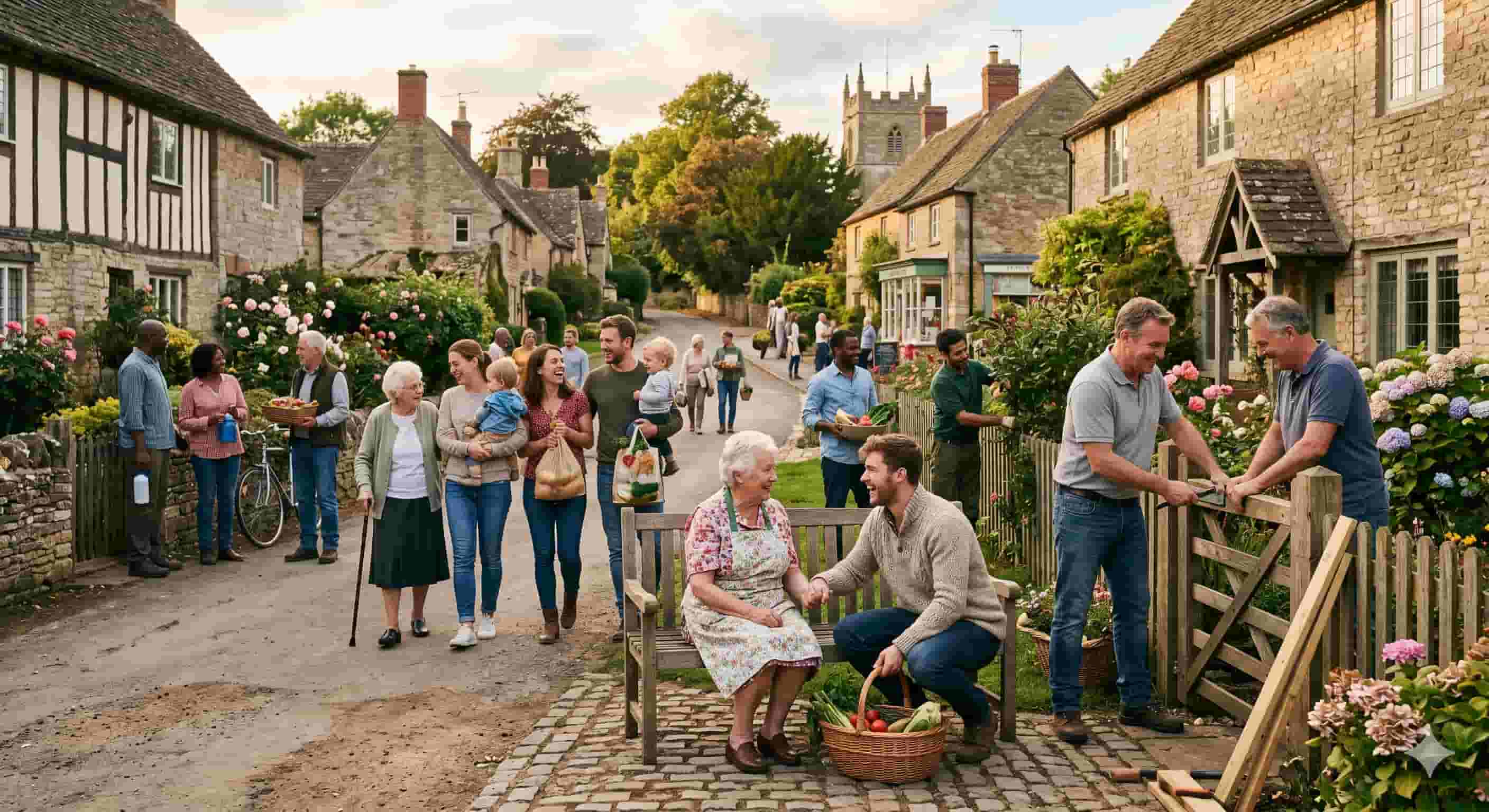
The Australian Picture: Disconnected and getting more so
Closer to home, economist Andrew Leigh — a Harvard-trained PhD in Public Policy and a former member of Putnam’s own research team — has brought this lens squarely to bear on Australia. His 2010 book Disconnected (UNSW Press) remains the landmark examination of Australian social capital since the 1960s. The findings are sobering:
- In 1967, roughly 33% of Australians were active members of an organisation. By 2004 that had fallen to 18% (Leigh, 2010).
- The number of community organisations per 10,000 Australian adults dropped from seven in the late 1970s to fewer than three by 2010.
- Church attendance, union membership, Scouts and Guides, Rotary, Lions, political engagement — on every measure, the data tells the same story of accelerating disconnection.
Leigh has continued to raise the alarm as a parliamentarian and is now Assistant Minister for Productivity, Competition, Charities and Treasury — arguing that the decline in social capital is one of the defining challenges facing the Australian economy and community alike. The subtitle of his ministerial portfolio is itself telling. Productivity and charities sit together because, as Leigh’s research has consistently shown, they rise and fall together.
When Dad went to Lodge and Mum took the school tuckshop roster
A generation of Australians watched Happy Days — the American sitcom that ran from 1974 to 1984 and made Henry Winkler (“The Fonze”) and Ron Howard (Richie) household names. The show was replete with the Americana of the era, including the attendance of Richie’s father Howard Cunningham at Leopard Lodge number 462, where club pursuits involved wearing a strange hat and striving to attain the title of “Grand Poobah.” The joke worked precisely because the practice was universal enough to be recognisable.
The Australian version of the same phenomenon was equally widespread. Fathers across the country were active in Apex, Lions, Rotary, or their local church. Mothers rostered themselves at school tuckshops, played tennis together, took turns walking neighbourhood children to school, and engaged in a steady rhythm of out-of-home community activities alongside the craft fads that knitted them together. It was the texture of ordinary suburban life — unremarkable enough, at the time, to go largely unrecorded.
Today, volunteering in community clubs has hit an all-time low in Australia and most Western economies. The sports facilities those volunteers helped build, the disability homes they fundraised for, the school supports they offered — all have been progressively professionalised and outsourced to government. In exchange for higher workforce participation rates, much of the Western world has quietly checked out of community life and begun waiting for the pay cheque instead.
The numbers behind the loss
The numbers are stark. Volunteering Australia’s data shows the rate of formal volunteering through an organisation fell from 36.2% of adults in 2010 to 28.8% in 2019. The decline was most pronounced among women, whose participation dropped from 38.1% to 28.1% over the same period (Volunteering Australia, 2024).
Then came the pandemic, which delivered a further blow from which the sector has not recovered. Formal volunteering fell to 26.7% in 2022, representing some 1.86 million fewer volunteers compared to pre-COVID levels. By October 2024 the rate had settled at around 28%, still well below the pre-pandemic baseline. In total, Australian volunteerism has fallen by more than 10% over the last decade — a trend mirrored in the United States and the United Kingdom (Volunteering Australia, 2024).
Queensland’s position is equally concerning. Volunteering Queensland’s State of Volunteering in Queensland 2024 report, produced in partnership with the Queensland Department of Human Services, found that volunteering rates in the state had dropped 10% in just three years. The Queensland Parliament took the crisis seriously enough to commission a formal inquiry through its Local Government, Small Business and Customer Service Committee. That inquiry received more than 570 written submissions and held 15 public hearings across the state, reporting its findings in September 2025 (Volunteering Queensland, 2024; Queensland Parliament, 2025). This is not a fringe concern. It goes to the heart of how communities function — and how the essential social glue that holds them together is coming unstuck generation by generation.
Two Tipping Points: Housing as investment, and the return to paid work
Income, meanwhile, is increasingly absorbed by housing. Houses in many suburbs are now substantially larger than those familiar to Australians growing up from the 1950s through to the 1990s. Leading Australian social psychologist Hugh Mackay AO, whose seventy-year career documenting the shifting texture of Australian life is captured in Australia Reimagined (2019) and most recently The Way We Are (2024), identifies two tipping points that have fundamentally altered society: the widespread belief that housing is an investment, and the return of women to the paid workforce in droves — not as a choice, but as an increasingly necessary contribution to household budgets where housing absorbs an ever-larger share of expenditure (Mackay, 2019; 2024).
Since 1975, housing costs have roughly doubled across major economies. Americans have seen rent rise from 13% of income in 1975 to 25% in 2025. Australia, a nation of home owners, has seen mortgage repayments lift from 37% of median monthly wages to 91% over the same period. That exposure means every Australian government of recent decades has been judged on how effectively it has delivered ever-rising house prices. Australians have so much of their wealth in property that any decline in net worth is deemed a major policy failure, regardless of what that decline might do for affordability.
Leigh’s Disconnected makes a directly relevant observation: longer working hours and longer commuting times — both driven in part by the housing affordability crisis and the push into outer suburbs — are among the key structural drivers of social capital decline (Leigh, 2010). When people spend more of their day working and travelling, the time available for the voluntary associations that hold communities together simply evaporates. This is not a matter of individual indifference. It is the structural outcome of economic pressures.
The architectural outcome is also consequential. Where Australians do succeed in securing a mortgage, it is increasingly in planned developments with very small lots and six-foot fences. A very different reality to the 1970s, when chain fences kept the dogs at home but children could easily climb between properties and neighbours could chat while gardening, hanging washing, or sitting on the back patio. Incidental contact — the raw material of neighbourhood — was frequent then. It is rare now.
More Australians rent than at any point in recent history. Rather than buy a house and raise children in a settled place, many move to wherever rents are tolerable and landlords hopefully kind. Frequent shifts produce little attachment to the local area. The appetite to join together to improve a park, start a sporting group, or build something socially useful declines at an alarming rate.
Loneliness as a public health crisis
The health consequences of this disconnection are far more serious than is commonly appreciated. Brigham Young University psychologist Julianne Holt-Lunstad has spent decades documenting the physical and mental health impacts of social isolation and loneliness. Her landmark 2015 meta-analysis, drawing on data from more than 3.4 million participants, found that loneliness is associated with a 26% increased risk of premature death, social isolation with a 29% increase, and living alone with a 32% escalation in mortality risk (Holt-Lunstad, Smith & Layton, 2015).
To put those numbers in perspective: in a 2023 advisory, the US Surgeon General stated that lacking social connection carries a mortality risk equivalent to smoking up to 15 cigarettes a day — a greater threat than obesity or physical inactivity (Murthy, 2023). Holt-Lunstad’s more recent work, published in World Psychiatry in 2024, documents that societal trends across multiple indicators show increasing rates of social disconnection, with a significant portion of the population now reporting persistent loneliness (Holt-Lunstad, 2024).
These are not soft social metrics. They are hard public health outcomes that drive demand on healthcare systems, including Australia’s. In the language of the Productivity Commission’s recent work on the care economy, loneliness sits upstream of a significant share of downstream cost — and is therefore an obvious candidate for prevention investment.
The Shape of Vanishing: Where the village has held, and where it hasn’t
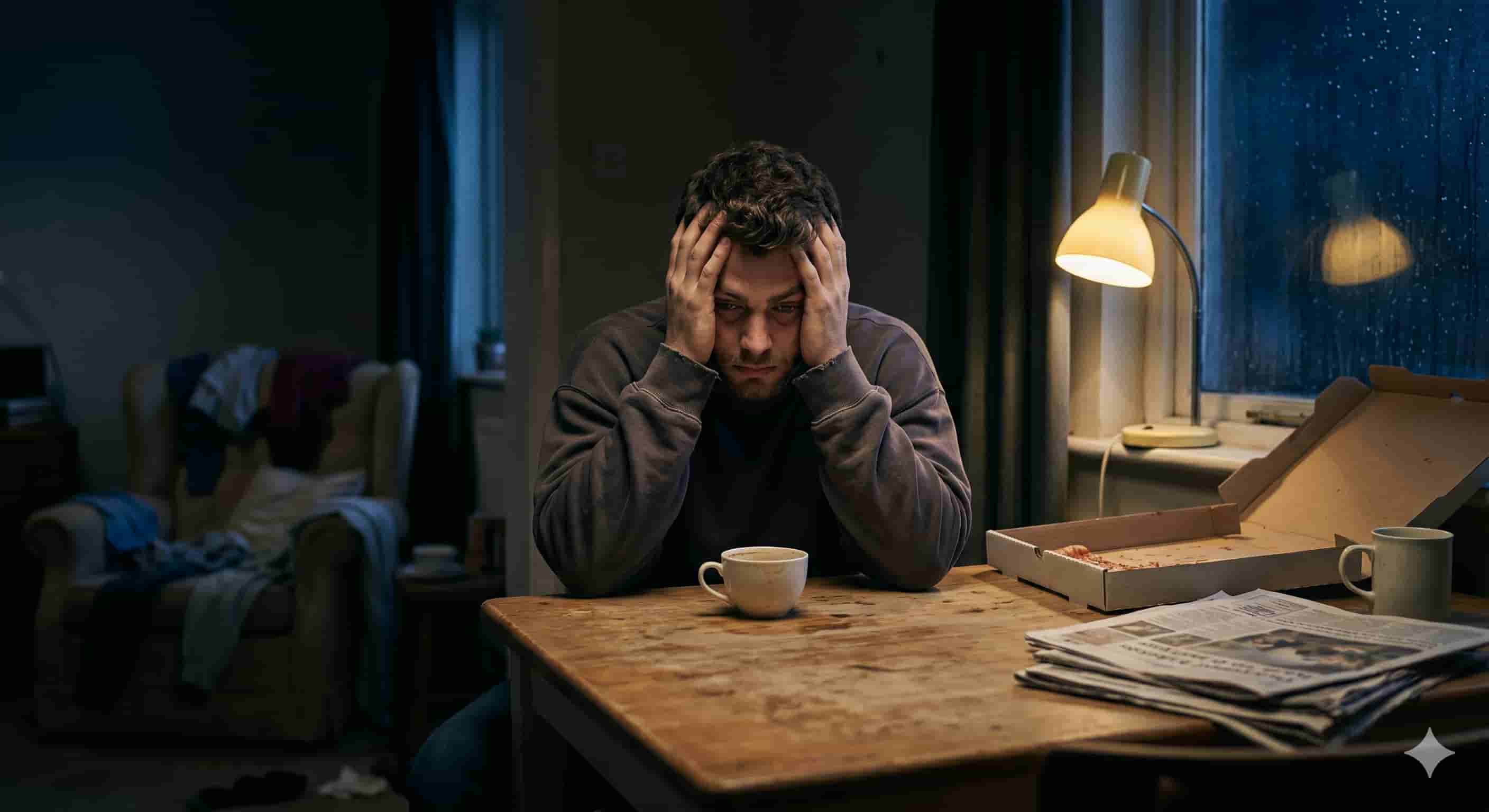
While the great Australian dream of property ownership persists, the reality is that the dream is beyond the means of many. And the communities built to realise it are vanishing. What is increasingly stark is that inner-urban and regional communities are maintaining their social infrastructure at rates unparalleled in the sprawl of Australia’s big cities. In the master-planned new-build communities on the metropolitan edges, tin rooftops rise rapidly — but places for community connection are often an afterthought. Councils across the country are being criticised for a lack of foresight on how much community space should be mandated where high-density living has become the norm.
The design of the built environment is no small matter in this. The work of Danish urbanist Jan Gehl, who has spent more than five decades studying how cities shape human behaviour — summarised in Cities for People (2010) and Life Between Buildings (2011) — has repeatedly demonstrated that incidental social contact is the foundation of community, and that it is either enabled or foreclosed by how streets, blocks, and shared spaces are designed (Gehl, 2010; 2011). Six-foot fences and car-dependent cul-de-sacs do not produce the chance encounters that build a neighbourhood. Well-designed streets and genuine public space do.
The investment case for social infrastructure
If household budgets are tighter than ever, what is the investment model for social infrastructure? Households in suburbs with more tree-lined streets, parklands, and community spaces net a clear premium when properties are sold. There is a generalised return from social fabric, but it is hard for any individual household to capture that return from an initiative they personally drive in their local area.
Government, however, can plausibly capture the return. More safe and interesting outdoor areas increase physical activity and reduce healthcare costs. More connected communities are more harmonious, safer, and less expensive to police and service. In the United States, large health insurers have started to routinely invest in community play and connection spaces as they see the direct benefits in fewer patients presenting with diabetes and mental health issues — some of the fastest-rising healthcare costs in the world.
England has been a world leader in social prescribing — investing in Link Workers and vouchers for social and nature-based activities to get populations moving and connected. The approach has been championed by the National Academy for Social Prescribing and embedded in NHS practice, with evidence that it reduces GP visits, A&E attendances, and hospital admissions for participants (NASP, 2024). Holt-Lunstad’s research provides the scientific underpinning for exactly this kind of investment, arguing that social connection must be treated as a formal public health priority on par with diet, exercise, and smoking cessation (Holt-Lunstad, 2024).
Australia’s fragmented healthcare system, underpinned by activity-based funding and private service provision, means there is little incentive for any particular provider to invest in preventative work. The cost would be direct. The benefits would accrue across providers, portfolios, and levels of government. This is the classic collective action problem in Australian health policy — and it is precisely the problem the Productivity Commission’s December 2025 report on delivering care more efficiently was asked to address.
The National Strategy: Volunteering as infrastructure
Volunteering Australia’s National Strategy for Volunteering 2023–2033 sets out a ten-year roadmap to reverse the decline, built around three central planks: improving the volunteer experience, comprehensively valuing volunteering, and increasing the number of active volunteers across the country. Its accompanying 2024–2027 Action Plan involves co-designed priority actions led by Volunteering Australia, the Department of Social Services, the Australian Sports Commission and the Australian Bureau of Statistics (Volunteering Australia, 2023).
Volunteering Queensland’s work — in particular its State of Volunteering series — provides the evidence base needed to make the case to Queensland policymakers that investment in the volunteering ecosystem is not a luxury but a social and economic necessity. The frame is the right one. What has historically been treated as an optional extra needs to be understood as infrastructure — as consequential for long-term social and economic outcomes as roads, broadband, or energy.
Happier than this
At the community level, dissatisfaction is growing with the standard offerings of councils and state and federal agencies. The outcomes from the investment of vast sums of public money are simply not translating into better health or improved happiness. In 2025, Australia ranked 11th in the World Happiness Report — falling out of the top ten for the first time since 2012 (Helliwell et al., 2025). The country that produced the carefree sunshine of Happy Days-era suburban community now ranks behind countries a fraction of its size, wealth, and natural endowment.
The problem is not that governments are spending too little. The problem is what the spending is buying. Fragmentation across portfolios has led to a reflexive focus on funding outputs — activity, services, throughput — rather than the outcomes citizens actually care about: connection, security, health, belonging. The Productivity Commission’s 2025 inquiry Delivering Quality Care More Efficiently made exactly this argument, building a substantial case for co-design and collaborative commissioning that meets needs at the community level (Productivity Commission, 2025). Broadbrush centralised programs miss the opportunities that exist to address the drivers of demand locally. Pooled budgets, combined resources, and more creative commissioning are positioned as keys to improving both the efficiency and the effectiveness of government spend.
Co-Design: From buzzword to method
“Co-design” keeps appearing in forums, conferences, and policy documents. Getting beyond mere consultation into the deep, community-led conversations that provide the foundation for co-investment is a different thing entirely. As Andrew Leigh has argued, it is individuals — not only governments — who have a role to play in creating vibrant communities and rebuilding social capital (Leigh, 2010). The invitation is therefore a practical one: give Australians the opportunity to participate as equals in discussions about what matters most to them, rather than having well-meaning middle-class bureaucrats decide what matters for them.
The Australian literature on how to do this well is strong. Kelly Ann McKercher’s Beyond Sticky Notes: Co-design for Real lays out four foundational principles that distinguish genuine co-design from better-dressed consultation: share power, prioritise relationships, use participatory means, and build capability (McKercher, 2020). She is direct about what this actually requires: there is no co-designing without co-deciding. If the community contributes insight but has no hand in the decision, the exercise has simply dressed up the old top-down approach in new language.
For those wanting a structured methodology, the Co.Design4All framework offers a practical 4D approach — Discover, Design, Decide, Debrief — supported by over 100 tools across fourteen stages. Its particular relevance to the social capital question is architectural: the framework is designed to make co-design accessible to anyone leading or navigating a significant change project, not just to trained facilitators. That matters, because if rebuilding social fabric is going to depend on a small cadre of professional co-designers, it will remain exactly the sort of top-down exercise it is supposed to replace.
— Discover surfaces who in the community is affected, who is missing from the room, and what the lived reality looks like — including from the people the system currently serves least well.
— Design builds solutions with community members, not for them.
— Decide commits the group to a shared path — with pooled budgets, joint accountability, and the kind of “co-commissioning” the Productivity Commission has recommended.
— Debrief closes the loop with structured reflection, so that both the intervention and the community’s own capability to design the next one are strengthened.
Used with genuine intent, this is how broadbrush centralised programs are replaced with something better — something local, owned, and actually capable of moving the outcomes that matter.
Trust, politics, and the window that may be open now
Trust in government has been falling in parallel with the social capital decline. In 2024, 44% of Australian respondents reported low or no trust in government institutions. Recent elections have felt like contests between the least-worst option rather than a genuine choice about the best potential government. That pattern is producing new political movements capable of destabilising Australian politics.
This is not a coincidental pairing. Putnam’s Italian research — and his later American work — found precisely this correlation: where social capital declines, trust in democratic institutions declines with it, and the legitimacy of government erodes at a pace that eventually outruns the capacity of any incumbent government to restore it (Putnam, 2000). The 2026 Edelman Trust Barometer has since documented this as a global phenomenon, with 70% of respondents across 28 countries unwilling or hesitant to trust someone whose values or background differ from their own (Edelman, 2026). A civic culture in which trust has retreated into immediate familiar circles is not a culture well placed to solve collective problems.
There is, however, a potential opportunity embedded in this. Those in power might see in co-design and new forms of collaborative commissioning a genuine opportunity to re-engage the voter blocs who are turning away from them. That would require accepting that the gap cannot be closed by better messaging — it can only be closed by better participation. The tools exist. The political will is the open question.
The village we still have time to rebuild
With a falling tax base, smaller numbers of working Australians are being asked to sustain the infrastructure of a larger and more complex society. Those same taxpayers are increasingly unable to afford the home ownership their parents took for granted. Their rising anxiety is understandable. It is also, on current trajectory, unlikely to resolve itself.
It may cost more in consultation and time, but the moment has arrived to engage with communities seriously — to stimulate their interest in improving the social fabric that surrounds them, and to define together the practical actions that can slow the rate of growth in government service-provision costs. The prize is substantial: communities that are more cohesive, more connected, more resilient — and, as a direct consequence, properties in them that are worth more.
The village that vanished did not disappear by accident. It was replaced by the structures and incentives of a different era. Rebuilding it will not happen by accident either. But it can happen — and, if the research of Putnam, Leigh, Mackay, Holt-Lunstad, and a generation of Australian practitioners is to be believed, it is the single most productive investment the country could make in its own future. Build it and we will come!
The community choirs won’t sing themselves. But they’re still worth singing for.
References:
- Co.Design4All (2025). The 4D Framework: Discover, Design, Decide, Debrief. Available at: https://codesign4all.com
- Edelman (2026). 2026 Edelman Trust Barometer Global Report. Available at: https://www.edelman.com/trust/2026/trust-barometer
- Gehl, J. (2010). Cities for People. Washington DC: Island Press.
- Gehl, J. (2011). Life Between Buildings: Using Public Space (6th ed.). Washington DC: Island Press.
- Helliwell, J. F., Layard, R., Sachs, J. D., De Neve, J.-E., Aknin, L. B., & Wang, S. (Eds.) (2025). World Happiness Report 2025. Oxford: Wellbeing Research Centre, University of Oxford.
- Holt-Lunstad, J., Smith, T. B., & Layton, J. B. (2015). Loneliness and social isolation as risk factors for mortality: A meta-analytic review. Perspectives on Psychological Science, 10(2), 227–237.
- Holt-Lunstad, J. (2024). Social connection as a critical factor for mental and physical health: evidence, trends, challenges, and future implications. World Psychiatry, 23(3), 312–332.
- Leigh, A. (2010). Disconnected. Sydney: UNSW Press.
- Mackay, H. (2019). Australia Reimagined: Towards a more compassionate, less anxious society. Sydney: Pan Macmillan Australia.
- Mackay, H. (2024). The Way We Are. Sydney: Allen & Unwin.
- McKercher, K. A. (2020). Beyond Sticky Notes: Co-design for Real — Mindsets, methods and movements. Sydney: Beyond Sticky Notes.
- Murthy, V. H. (2023). Our Epidemic of Loneliness and Isolation: The U.S. Surgeon General’s Advisory on the Healing Effects of Social Connection and Community. Washington DC: U.S. Department of Health and Human Services.
- National Academy for Social Prescribing NASP. Evidence on social prescribing: Impact on healthcare utilisation. London: NASP.
- Productivity Commission (2025). Delivering Quality Care More Efficiently: Inquiry Report. Canberra: Australian Government (released 19 December 2025; tabled in Parliament 29 January 2026).
- Putnam, R. D. (2000). Bowling Alone: The Collapse and Revival of American Community. New York: Simon & Schuster.
- Putnam, R. D., Leonardi, R., & Nanetti, R. Y. (1993). Making Democracy Work: Civic Traditions in Modern Italy. Princeton: Princeton University Press.
- Queensland Parliament (2025). Inquiry into volunteering in Queensland: Report of the Local Government, Small Business and Customer Service Committee. Brisbane: Queensland Parliament.
- Volunteering Australia (2023). National Strategy for Volunteering 2023–2033. Canberra: Volunteering Australia.
- Volunteering Australia (2024). Key Volunteering Statistics. Available at: volunteeringaustralia.org
- Volunteering Queensland (2024). State of Volunteering in Queensland 2024. Brisbane: Volunteering Queensland.