The most useful observations about a system almost always come from the people it serves least well. The trouble is that we tend to exclude them.
Most adults can still remember the small thrill of a merry-go-round — those Victorian inventions that have delighted children at fairs, fetes, and exhibitions for generations. On a fast one (slightly more modern than the originals), the seats closest to the centre of the turning circle produce less of a sensation. The seats on the outside create more centripetal force, which makes the whole experience considerably more exciting. And the view from out there is better.
The same dynamic applies to systems.
The view from the outer seats

Those closest to the centre of a system — the designers, the long-term incumbents, the beneficiaries — have a comparatively comfortable time. They built the system, or they are so familiar with it that it just seems to fit. Those at the edges experience something much more jarring. The system was not designed as well for them, so it is easier for their heads to feel the full force of its motion. No wonder frustration is the constant experience of the outliers.
Repeatedly, when time is spent consulting with the outliers in a system, service, or situation, they turn out to have the sharpest observations. The further out from the centre of the action, the more time a person has to notice patterns and see the forest for the trees. That means the people on the periphery have the greatest capacity to transform a system — which, if listened to, makes things better for everyone. Being in the “out” group becomes, for once, a powerful contribution to change driven by the “in” group.
And yet, outliers are routinely excluded from engagement. They appear “hard to serve.” The centre’s focus on its own system, and its quiet affection for it, means that the system tends to get preferred over the people it is supposed to serve. Language reflects this. Just because someone is “non-compliant” is not an occasion for judgement; it is an invitation to ask how the service might be made easier to comply with.
The fundamental attribution error
There is a well-established name for the habit of blaming individuals for what is actually a system problem. In 1977, the Stanford social psychologist Lee Ross coined the term fundamental attribution error to describe a consistent pattern in how humans explain other people’s behaviour (Ross, 1977). When someone else behaves badly, people tend to attribute it to their character. When they themselves behave badly, they tend to attribute it to the situation they were in.
It is a small psychological quirk with enormous organisational consequences. Apply it at scale and it produces a society that routinely mistakes system outcomes for individual failings — and then responds with more individual-focused interventions that do nothing to address the real driver.
The late W. Edwards Deming, the American statistician whose work on quality management is widely credited with transforming post-war Japanese manufacturing, captured the consequence with characteristic bluntness at a 1993 seminar in Phoenix: “A bad system will beat a good person every time” (Deming, 1993). The line wasn’t fatalism. It was an instruction: stop exhorting people to try harder inside a broken system, and redesign the system so that the right behaviour is the natural behaviour. The Deming Institute, which preserves his legacy, has noted that his whole intellectual project was about the futility of blame as a management strategy — and the productivity of redesigning the environment that produces the behaviour (Deming Institute, 2018).
The selective moral spotlight
The attribution error plays out most clearly in where society directs its moral energy. A few examples illustrate the pattern.
Sex work and the pornography industry
History is full of examples of sex workers being treated appallingly by police, media, and community players. Meanwhile, a comparative blind eye has been turned to the commercial pornography sector, which has moved decisively onto online platforms and is now among the world’s largest global economic industries. Research by the Australian eSafety Commissioner and by scholars such as Dr Maree Crabbe, whose “It’s Time We Talked” project has documented young people’s exposure to online pornography in Australia, identifies a rapidly worsening landscape of exposure, normalisation, and harm — including to children (Crabbe & Corlett, 2011; eSafety Commissioner, 2023). Public conversation about the industry remains sparse. Public condemnation of individuals continues unabated.
Fraud, petty theft, and the tax system
Action is routinely taken against those who commit fraud or small-scale theft. Systematic scrutiny of the use of lawyers and tax agents to minimise tax — entirely legal, entirely engineered by those with means — remains comparatively rare. The net effect, documented by UC Berkeley economists Emmanuel Saez and Gabriel Zucman in The Triumph of Injustice (2019), is that those on lower incomes increasingly bear a proportionally larger burden of tax than those at the top. The individuals who underpay are called thieves. The institutions that help the wealthy underpay are called firms.
Gambling, poker machines, and community “benefit”
Perhaps the most striking Australian example concerns gambling. Australia has the highest per-capita concentration of electronic gambling machines in the world. Associate Professor Charles Livingstone at Monash University, one of the country’s foremost critical gambling researchers, has spent more than a decade documenting the pattern (Livingstone, 2012; Livingstone et al., 2014). Poker machines account for the majority of gambling-derived harm in Australia, and losses are concentrated in the most socioeconomically disadvantaged suburbs and electorates. The industry’s defence — that the revenue funds community sporting and charitable activities — has been shown by Livingstone’s research to be largely a smokescreen: community contributions represent only a small fraction of poker machine losses, and the people losing the money are rarely the same people benefiting from the community grants.
The individuals who develop gambling problems are described as “problem gamblers.” The machines specifically engineered to be addictive, and the commercial arrangements that place them in the suburbs least able to absorb the losses, attract far less public scrutiny.
Violence — and the appetites that surround it
Society punishes those engaged in assault and violent acts. Meanwhile, violent video games are a multi-billion-dollar industry, violent films dominate the box office, and war coverage glorifies rather than interrogates the violence it describes. The individual is held to account. The systems that produce and commercialise the appetite are not. The leaders who take their countries to war become memorialised whilst the bloke who had a bad day and lashed out ends up in jail for breach of the peace.
Wealth, greed, and the Gordon Gekko problem
Public discourse condemns the Gordon Gekko figure — the ruthless pursuit of wealth and arrogant display of success from the 1987 film Wall Street — while simultaneously venerating the path to riches. The cultural and political advocacy deployed by the affluent to protect assets and business concessions rarely receives the same treatment. The flashy villain is easy to see. The systemic architecture of wealth protection is not.
The pattern is consistent: condemnation focuses on individuals; systems and industries that drive far greater dysfunction at a societal level escape sustained attention.
The evidence on what systems do
When the academic lens is turned on the systems themselves, the evidence is consistent. British epidemiologists Richard Wilkinson and Kate Pickett, in their 2009 book The Spirit Level: Why More Equal Societies Almost Always Do Better, compiled data across developed countries to show that almost every social problem considered worse in “worse” people — violence, teenage pregnancy, poor educational outcomes, addiction, mental illness, incarceration — correlates more strongly with the level of inequality in a society than with anything about the individuals concerned (Wilkinson & Pickett, 2009). The spirit-level metaphor was chosen deliberately: the system tilts, and outcomes slide downhill accordingly.
British epidemiologist Sir Michael Marmot’s work for the WHO Commission on Social Determinants of Health — Closing the Gap in a Generation (CSDH, 2008) — reaches the same conclusion from a health angle. Population health outcomes, Marmot argues, are shaped far less by the healthcare system and far more by the conditions in which people are born, grow, live, work, and age. These are not individual lifestyle choices. They are the designed features of the social system itself.
Where to Intervene: leverage points
Donella Meadows, the late American environmental scientist and systems thinker whose book Thinking in Systems (2008, published posthumously) remains the classic introduction to the field, spent her career identifying where in a system small interventions produce disproportionate change. Her famous list of leverage points ranks paradigms — the shared beliefs and assumptions that define what is thinkable — as the single most powerful place to intervene in any system (Meadows, 2008). Change the paradigm, and downstream behaviours reorganise themselves.
Applied here, the relevant paradigm shift is the one Deming was pointing at in 1993: from the individual is the problem to the system is producing the outcome we’re seeing. Making that shift is not a technical adjustment. It is a reorientation of how institutions, media, policymakers, and communities interpret the behaviour in front of them.
From Critique to Co-design: Turning insight into action
Systems critique alone doesn’t change systems. The insight has to be turned into designed-in improvement — and the people best placed to guide that redesign are the ones on the periphery who see the system most clearly.
Australian practitioner Kelly Ann McKercher, in Beyond Sticky Notes: Co-design for Real, sets out the four foundational principles that distinguish genuine co-design from better-dressed consultation: share power, prioritise relationships, use participatory means, and build capability (McKercher, 2020). She is direct about what this actually requires: there is no co-designing without co-deciding. If the people at the periphery contribute to the insight but have no hand in the decision, the fundamental attribution error hasn’t been challenged; it has just been repackaged.
Systems Change through co-design
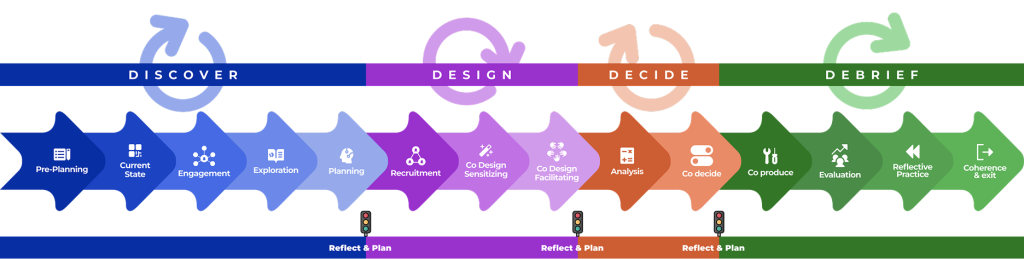
For those wanting a structured approach, the Co.Design4All framework offers a practical 4D methodology — Discover, Design, Decide, Debrief — supported by over 100 tools across fourteen stages. It is designed to make co-design accessible to anyone leading or navigating a significant change project. Its usefulness for systems change rests on a particular architectural decision: the framework explicitly centres the people most affected by the system, rather than the people most invested in it.
- Discover surfaces who is actually being served well by the current system and who is being served badly — and makes sure the latter voices are in the room from the outset, not consulted at the end.
- Design builds solutions with those affected by the system, not on behalf of them.
- Decide tests whether the group has genuinely heard the periphery’s insights or quietly reverted to the centre’s preferences.
- Debrief closes the loop with structured reflection, including on whose voices were heard and whose were not.
Used well, a co-design framework does more than improve a service. It addresses a systemic pattern: the quiet exclusion of the outliers whose experience contains the most useful information for the system’s own improvement.
The outsider advantage
For those involved in placemaking, community development, and service redesign, this has practical implications. The first discipline is to challenge the instinct to look for individual reform, and instead look at system effects. What does the big picture say about who is in the “in” crowd and who is excluded? Where is it easy to get results, income, and accolades, and where is it hard? Leaning into those on the outside — those most affected by the system — produces the insights most capable of transforming it.
Something else happens when systems thinking is taken seriously: it can be liberating for those who have been marginalised. When the insights they bring lead to widespread recognition that the system has inadvertently been against them, the result is less self-doubt, less self-criticism, and more legitimate standing as partners in change. Having been told for years that the problem was their behaviour, their compliance, or their choices, the discovery that the system itself was tilted against them is itself a form of repair.
That realisation can feel as exhilarating as the wildest ride at the community fair. And unlike the merry-go-round, the ride doesn’t stop when the music ends — it keeps producing better outcomes, for everyone, long after the project wraps up.
Fix the ride, not the rider. That’s where systems change starts.
References
- Co.Design4All (2025). The 4D Framework: Discover, Design, Decide, Debrief. Available at: https://codesign4all.com
- Commission on Social Determinants of Health [CSDH] (2008). Closing the Gap in a Generation: Health Equity through Action on the Social Determinants of Health. Final Report of the Commission on Social Determinants of Health. Geneva: World Health Organization.
- Crabbe, M., & Corlett, D. (2011). It’s Time We Talked: Pornography’s influence on young people. Reality & Risk project, Brophy Family and Youth Services.
- Deming, W. E. (1993). Four-day Deming seminar, Phoenix, Arizona, February 1993. Attributed in W. Edwards Deming Institute archive.
- Deming Institute (2018). A bad system will beat a good person every time. The W. Edwards Deming Institute. Available at: https://deming.org
- eSafety Commissioner (2023). Encounters with online pornography: Research from the eSafety Commissioner. Australian Government.
- Livingstone, C. (2012). Assessment of poker machine expenditure and community benefit claims in selected Commonwealth Electoral Divisions. Report for UnitingCare Australia. Melbourne: Monash University.
- Livingstone, C. H., Rintoul, A., & Francis, L. J. (2014). What is the evidence for harm minimisation measures in gambling venues? Evidence Base, 2, 1–24.
- McKercher, K. A. (2020). Beyond Sticky Notes: Co-design for Real — Mindsets, methods and movements. Sydney: Beyond Sticky Notes.
- Meadows, D. H. (2008). Thinking in Systems: A Primer. White River Junction, VT: Chelsea Green Publishing.
- Ross, L. (1977). The intuitive psychologist and his shortcomings: Distortions in the attribution process. In L. Berkowitz (Ed.), Advances in experimental social psychology (Vol. 10, pp. 173–220). New York: Academic Press.
- Saez, E., & Zucman, G. (2019). The Triumph of Injustice: How the Rich Dodge Taxes and How to Make Them Pay. New York: W. W. Norton.
- Wilkinson, R., & Pickett, K. (2009). The Spirit Level: Why More Equal Societies Almost Always Do Better. London: Allen Lane.