The change work of this generation will test character before it tests competence. In a culture that has spent sixty years prizing self-esteem over self-mastery, humility may be the most important leadership capability still left to rebuild.
Good change work sits at the intersection of science and the social sciences. The scientific method offers the discipline of hypothesis, evidence, and revision. The social sciences offer something equally valuable: the capacity to work in the messy grey of qualitative inquiry, where not everything is black and white. Helping people and groups deliver their best involves very few absolutes. It does, however, involve repeated engagement with a quieter question: what does it take for a person to lead well through a long, hard change?
That is, at its core, a question about character. Increasingly, it is a question that our Western culture is struggling to answer.
Moral Ecology: Why place shapes conduct
The concept of moral ecology — popularised in recent years by American commentator David Brooks — captures an idea that anyone who has lived across regions of Queensland will recognise instinctively. Each society, and even each local community, develops its own moral ecology: a particular set of norms, assumptions, beliefs, and habits that fit that setting and shape the behaviour of the people within it (Brooks, 2015).

The texture shows up in small things. It is perfectly reasonable, in the Scenic Rim, to leave a $100 note in a box at a farm gate with a handwritten order for sunflowers to be ready in three days for an event. The flowers will be cut and ready — no texts, no reminders, no further contact required. Country communities are reliable like that, because the consequences of unreliability are real: gossip and ostracism play their role in reinforcing behaviour in a place where everyone knows everyone.
Leave the same $100 in a letterbox in inner Brisbane with a hastily scribbled note, and the outcome is less certain. In a teeming metropolis, people are more invisible and less connected to one another. The social mechanisms of reciprocity that operate in small communities are diluted. Same country, same currency, different moral ecologies.
Australian social researcher Hugh Mackay AO has spent more than six decades documenting this pattern in the Australian context. In The Art of Belonging (2014) and again in The Way We Are (2024), Mackay has argued that neighbourhoods and communities are not incidental to how people behave. They are the substrate of it. Local belonging does much of the invisible work of holding individuals to standards they might not hold themselves to alone (Mackay, 2014; 2024).
From Aristotle to the selfie
Each setting has its own character. But there are also big-picture drivers shaping the moral ecology of society at large — and it is worth taking those seriously.
British journalist Will Storr’s book Selfie: How We Became So Self-Obsessed and What It’s Doing to Us (2017) traces this arc with unusual care. Storr opens with Aristotle in ancient Greece, reflecting on what character was understood to be: a set of cultivated virtues, practised over time, that made a life worth living. He closes by tracing the long cultural path to the present — a society in which sharing images of meals and videos of rambling personal thoughts is treated as an unremarkable pastime (Storr, 2017).
Storr’s argument is that millennial narcissism, as it is sometimes dismissively called, is not a fault of young people. It is the downstream effect of a much older cultural shift. The self-esteem movement, born in California in the 1960s and institutionalised across schools, parenting advice, and popular psychology from the 1980s onward, became one of the unquestioned pillars of Western thinking. Build your self-esteem, the logic went, and do what is right for you, and you will find the joy you deserve.
Psychologist Jean Twenge, who has studied cross-generational data on self-focus for more than two decades, has documented the measurable consequences. In Generation Me (2006) and The Narcissism Epidemic (Twenge & Campbell, 2009), Twenge found that college students now score higher on the Narcissistic Personality Inventory than any previously measured cohort, that empathy scores have declined, and that expectations have outpaced reality (Twenge, 2013). Her conclusion is pointed: attempts to build self-esteem without a corresponding basis of achievement or connection tend to produce an inflated sense of self rather than a grounded one.
The Old Alternative: Happiness as by-product, not goal
The inversion is worth sitting with. For most of human history, happiness was not something to be pursued as a goal in itself. It was an occasional reward for a life well lived alongside people worth living for. Commitment to community — to family, to neighbours, to institutions, to shared endeavour — led to the kind of collective action that built bridges, literal and metaphorical, and improved the way a society functioned.
The modern alternative has been to raise a generation whose parents’ dominant strategy was to ensure their small number of children had the very best: no pain, no struggle, no unnecessary obstacles. Struggle was reframed as something that might undermine self-confidence and happiness. The intention was good. The evidence suggests the outcome has not been.
This is where American social psychologist Jonathan Haidt’s 2024 book The Anxious Generation picks up the thread. Haidt documents the paradox directly: as Western societies became more protective of children in the physical world — limiting unstructured outdoor play, minimising risk, managing every discomfort — they simultaneously under-protected them in the virtual world, where smartphone-mediated social media exposed them to comparison, anxiety, and attention fragmentation at unprecedented scale (Haidt, 2024). The resulting mental health trends among adolescents since approximately 2012 are well-documented, even where the precise causal mechanisms remain contested.
Where Storr maps the cultural shift and Twenge measures it, Haidt examines what it is producing in the generation currently coming of age.
Grit, character, and the long climb
Against this backdrop, Angela Duckworth’s work on grit is best read as a corrective. Duckworth, a University of Pennsylvania psychologist and MacArthur Fellow, defines grit as passion and perseverance for long-term goals (Duckworth, 2016). Her decade of research, including longitudinal work with West Point cadets, spelling bee finalists, and teachers in challenging schools, found that sustained effort toward a meaningful goal was a stronger predictor of success than raw talent or IQ.
Duckworth’s central insight is that challenge is what builds grit. It is the encounter with the outer limits of current knowledge and capability that creates both the awareness of those limits and the capacity to push through them. Goals calibrated well below what someone can achieve produce little growth. Goals large enough to demand persistent effort — with room for failure and recovery — produce both the achievement and the internal resource to attempt something harder next time.
Finding the inner resource to keep climbing when the track becomes long, hard, and daunting requires something that only develops through doing hard things. If a person’s existence has been organised around the external validation of likes, shares, and positive comments, the stamina to pursue a serious, long-term goal is unlikely to be there when it is needed.
This is the foundation of character.
The communities shaped by expectation without reciprocity
The practical implications show up in communities. A growing share of Australians now hold the view that government and other service providers should deliver for them, with a corresponding inner frustration when the world does not arrange itself accordingly. This frustration is part of what is driving the mass disillusionment with politics and civil society visible across Western democracies.
Escapism absorbs much of the pressure. Streaming services, online shopping, and food delivery address the need for instant gratification and the preference for a world that can be controlled from a screen. In the civic sphere, the same dynamic produces a particular kind of commentator: the individual who is happy to explain what should be happening but makes no corresponding commitment to its delivery. Online, these voices will engage in brutal commentary about the work of paid or volunteer change agents because their opinion feels important — to them — and the consequences of their distributed anger are distant enough to be someone else’s problem.
The 2026 Edelman Trust Barometer — based on nearly 34,000 responses across 28 countries — provides the broader evidence for the pattern. It documents a global retreat into insular circles of trust, with 70% of people unwilling or hesitant to trust someone whose values, background, or approach differs from their own (Edelman, 2026). A civic culture in which people increasingly only trust those who already agree with them is not a culture likely to produce the shared effort that significant social change requires.
For the people actually doing the ongoing work of societal reform, this can leave them feeling alone, criticised, and exposed to the braying wolves. Their character will be tested. What matters in that moment, rather than self-esteem, is something more enduring.
Humility as the foundation of character
David Brooks’ 2015 book The Road to Character is perhaps the most thoroughgoing contemporary articulation of what such character looks like. Brooks builds the book around a distinction, drawn from the 20th-century theologian Rabbi Joseph Soloveitchik, between two sides of human nature: Adam I — the external, ambitious, career-driven, résumé-building self — and Adam II — the internal, moral, humble, eulogy-building self (Brooks, 2015).
The contemporary challenge, Brooks argues, is that modern culture nurtures Adam I almost exclusively. Children are raised to cultivate strengths, parade achievements, and compete for external markers of success. Adam II is left to sleepwalk. The consequence is a humiliating gap — Brooks’s phrase — between the actual and desired self, and a vague unease that a life spent accumulating wins has not actually delivered the meaning it promised.
Brooks’ study of twentieth-century figures — including Frances Perkins, Dorothy Day, George Marshall, Dwight Eisenhower, A. Philip Randolph, Bayard Rustin, Viktor Frankl, and Martin Luther King Jr. — led him to a set of propositions that he calls a humility code. Paraphrased and condensed for the present purpose, they might be stated as follows (after Brooks, 2015):
- Seek a life of purpose, not pleasure. Pleasure fades; purpose sustains.
- Accurately see the self. Recognise the innate tendency to treat oneself as the centre of the universe, and the way that tendency turns strengths into failures.
- Confront inherent flaws. Wrestle with the divided self and tame its worst tendencies rather than pretending they are not there.
- Accept being an underdog to one’s own nature. Mistakes and false starts are inevitable until weaknesses are understood.
- Tame pride. Guard against the blindness that comes with thinking one is better than one is.
- Fight the inner battles first. External battles of will with others pale against the depth of one’s own internal conflicts.
- Treat life as ongoing confrontation with one’s humanity. Improved behaviour comes through discipline, consideration, and self-control, not insight alone.
- Distinguish short-term calls from long-term work. Lust, fear, vanity, wealth, and independence are short-term. Courage, honesty, humility, and attachment to important things are long-term.
- Rely on family, friends, traditions, and institutions. Character is only achieved together — with the example of heroes and sometimes of faith.
- Accept that everyone will need grace at some point. Messing up is inevitable; openness to the support of others is not weakness but maturity.
- Be quiet enough to hear opportunity. Ego blocks the capacity to see strengths and options the world might quietly be offering.
- Gain wisdom through smallness. Recognise how little one knows in comparison to the complexity that must be navigated, and be open to insight from others.
- Serve others, not the self. Vocation comes from looking outward to what the world is asking, not inward to what one wants from it.
- Extend kindness to flawed others. Human nature is flawed; everyone in any shared endeavour will sometimes be selfish, self-deceiving, or narrow. So be kind.
- Earn maturity. It is not bestowed by intellect, biology, or circumstance. It is the capacity to be dependable under pressure and straight under temptation, anchored by a purpose larger than oneself — and to know how often to say no in order to be available when it is time to say yes.
This is a very different list from one that would emerge from a world that urges people to discover their authentic self and do only what feels good.
Servant leadership and the practice of self-mastery
The leadership implications are clear, if difficult. In 1970, former AT&T executive Robert K. Greenleaf published an essay titled The Servant as Leader that proposed what remains a radical reframing of how leadership is understood. The servant-leader, in Greenleaf’s formulation, is servant first — beginning with the natural feeling that one wants to serve people, and only then making the conscious choice to aspire to lead (Greenleaf, 1970). This is the opposite of leader-first, which is typically driven by an unusual power drive or the need to accumulate status and wins. The former focusses on the people elements, the latter the power and achievement parts of the Human Motivation Theory triangle popularised by David McClelland.
Greenleaf’s test for whether servant leadership is genuinely happening is stringent: do those being served grow as people? Do they become healthier, wiser, freer, more autonomous, more likely themselves to become servants? And what of the least privileged — do they benefit, or at least not loose further ground (Greenleaf, 1977)? These are operational questions, not rhetorical ones, and they apply with full force to anyone leading a change process in a community or organisation.
The difficulty of this kind of leadership is that it cannot be performed. It has to be practised. It also has to be built on self-mastery, because a leader who has not wrestled with their own ego, pride, and blind spots will tend to project those onto the work, the team, and the community.
The invitation, and the harder question
Mahatma Gandhi’s exhortation to “be the change you wish to see in the world” is now printed on coffee mugs and inspirational posters. What is less often remembered is what his later life actually involved: sustained ascetic practice, constant self-examination, and a long wrestle with who he was and what it meant to lead one of the largest change movements in history.
The invitation, for anyone doing meaningful change work today, is to hold the same two questions in view at once. What change does the world need? And what change does that require of the person trying to lead it?
The current moral ecology is skilled at asking the first question and tends to skip the second. A different set of questions — the Adam II questions, the Duckworth questions, the Greenleaf questions — is harder to sit with in a busy, noisy life organised around external achievement. But they may be the most important questions a person can ask if they are serious about leading anything meaningful.
Leadership, on this account, begins not with competence but with self-mastery. And without others willing to follow the example set, there is no leadership at all — which is why the world needs more examples of humble servant-leaders who are determined to do the right thing, quietly, over time, in the places where it matters.
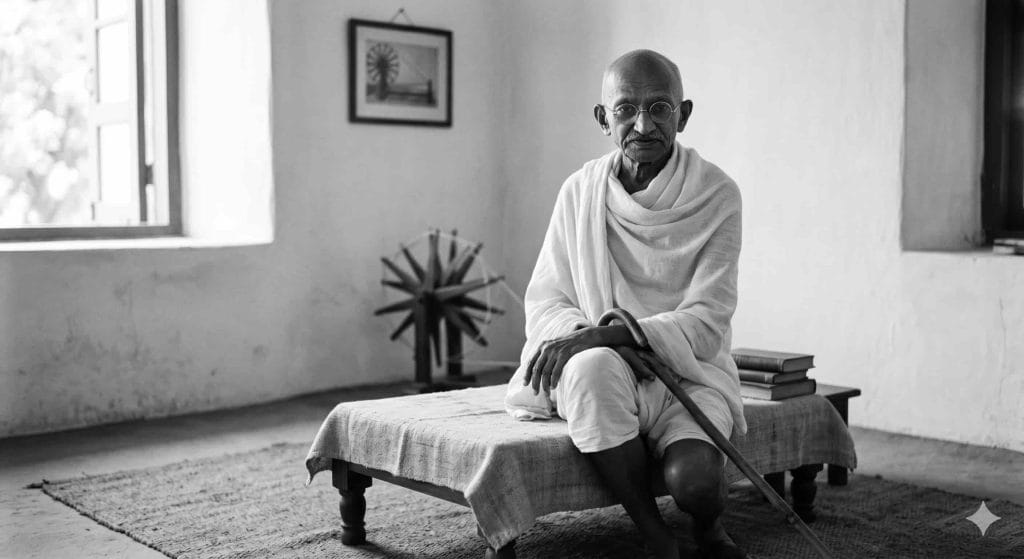
Character, not credit. The distinction may be the defining difference between success and failure.
References:
- Brooks, D. (2015). The Road to Character. New York: Random House.
- Duckworth, A. (2016). Grit: The Power of Passion and Perseverance. New York: Scribner.
- Edelman (2026). 2026 Edelman Trust Barometer Global Report. Available at: https://www.edelman.com/trust/2026/trust-barometer
- Greenleaf, R. K. (1970). The Servant as Leader. Indianapolis: Robert K. Greenleaf Center.
- Greenleaf, R. K. (1977). Servant Leadership: A Journey into the Nature of Legitimate Power and Greatness. New York: Paulist Press.
- Haidt, J. (2024). The Anxious Generation: How the Great Rewiring of Childhood Is Causing an Epidemic of Mental Illness. New York: Penguin Press.
- Mackay, H. (2014). The Art of Belonging: It’s not where you live, it’s how you live. Sydney: Pan Macmillan Australia.
- Mackay, H. (2024). The Way We Are. Sydney: Allen & Unwin.
- Storr, W. (2017). Selfie: How We Became So Self-Obsessed and What It’s Doing to Us. London: Picador.
- Twenge, J. M. (2013). The Evidence for Generation Me and Against Generation We. Emerging Adulthood, 1(1), 11–16.
- Twenge, J. M., & Campbell, W. K. (2009). The Narcissism Epidemic: Living in the Age of Entitlement. New York: Free Press.