A great idea is not enough. Funding, permission, and momentum go into the pitch that speaks to all three planks at once — in the right order for the audience in the room.
It is easy to become disillusioned with driving change. Attention is hard to win. Resources are harder. Over decades of reform efforts, one pattern recurs with unwelcome consistency: pitching for an idea is as much an art as it is a science. What we learnt is that the conviction of the advocate is no substitute for the discipline of the pitch.
Just because a change-maker believes in an idea does not mean others will embrace it quickly. The pitch has to be translated into the terms the audience can actually hear. A useful, battle-tested communication structure for this translation is the Head, Heart, Hip Pocket framework.
The three planks of the change-pitch raft
Change is often experienced as a disruption of the quiet, slow-moving river of professional life. It introduces rapids and unpredictable waters. Covering the facts, the emotional elements, and the financial realities of a pitch — all three — addresses the common planks needed to build a raft that can carry an idea across those rapids.
The advocate has to be the person who communicates across all three domains, because different members of the audience are attuned to different elements. A CFO will not uusally be convinced by a heartwarming story. A clinical champion will not be moved by a spreadsheet. A community board member may care about all three but in a particular order. Fail to cover any one of the three and the raft won’t hold together.

Head: The rational case
Some audiences are highly analytical or tied to the technical aspects of their profession. They need to know how large the problem actually is and why the proposed solution makes sense. That means numbers, comparable projects, and a credible evidence base. They want details. They want links to strategy. They want project plans. Those details have to be grounded in reality, verifiable, and well organised.
Nobel laureate Daniel Kahneman’s work on two-system thinking, summarised in Thinking, Fast and Slow (2011), describes “System 2” — the slow, deliberate, analytical mode of reasoning that weighs evidence and considers risk (Kahneman, 2011). Some audiences live most of their professional lives in System 2. They experience a pitch without rigorous analysis as inconsequential, and they are not wrong to do so. Without the head plank, the advocate is asking people to take risk with no underpinnings as to why change is actually necessary.
Heart: The people at the centre of the change
All change involves people. It also impacts people. “Heart” audiences want to know that the proposal is achievable for their team, good for the reputation of the organisation, and has positive impacts on clients or service users. Some will even be excited about the novelty of the solution and the chance for the organisation to be recognised for innovation. Emotion is their mother tongue, and people are the story they want to hear.
Harvard Business School’s John Kotter, writing with Dan Cohen in The Heart of Change (2002), made one of the most consequential observations in modern change literature: most large-scale change efforts fail not because the analysis is weak, but because the emotional engagement is absent. Kotter and Cohen argue that successful transformations follow a see–feel–change pattern rather than the more intuitive analyse–think–change sequence (Kotter & Cohen, 2002). People don’t change what they do primarily because they’ve been shown data. They change what they do because they’ve been shown something that shifts how they feel.
This is why a strong heart pitch includes a patient journey or customer case study, testimonials, stakeholder support statements, and a clear description of how the world will actually be better after the change. It notes how the new model makes life easier for the teams delivering the service, and better for the organisation as a whole. These are not decorative additions to the technical case. They are the core of whether the change gets over the line.
Hip Pocket: The resource reality
Every organisation is caught in the resource constraints of its setting. Fiscal realities mean that competing for funding is an everyday occurrence. A change proposal may have solid evidence. It may have stakeholder support. It may have a project plan that minimises risk and maximises the chance of good outcomes. But if it fails to show a return on investment higher than the competing calls on the same budget, it will still fall short.
This is why understanding the hip-pocket realities of every funder matters. A credible hip-pocket plank answers the operational questions every treasurer, executive and board chair already has in their head:
- Will this project save money, or generate revenue?
- Over what timeframe will payback be achieved?
- How sensitive is the business case to its assumptions? What changes in volume, price, or implementation cost would turn a positive return negative?
- What are the alternative financing options, and why is this proposal the most sensible?
Leaving these questions unanswered — or worse, answering them with enthusiasm rather than analysis — tells the hip-pocket audience that the advocate hasn’t done the work. In most funding environments, that is the point at which polite interest quietly evaporates.
The Ancient Foundation: Logos, pathos, ethos
The head, heart, hip pocket framework is not a new invention. It is a modern expression of the oldest structure in persuasion. In the fourth century BCE, Aristotle identified three modes of appeal in Rhetoric: logos (appeal to reason), pathos (appeal to emotion), and ethos (appeal to credibility and character). Every effective pitch, he argued, draws on all three (Aristotle, trans. Kennedy, 2007).
Modern behavioural science has given the same argument additional structure. Stanford’s Chip Heath and Duke’s Dan Heath, in Switch: How to Change Things When Change Is Hard (2010), popularised the Rider–Elephant–Path framework, drawing on social psychologist Jonathan Haidt. The Rider is the rational mind. The Elephant is the emotional mind. The Path is the environment in which the decision is being made. To create change, all three have to be addressed: direct the Rider, motivate the Elephant, and shape the Path (Heath & Heath, 2010). Head, Heart, and Hip Pocket cover the same territory in a way that is easier to remember at three in the morning when a grant application is due.
Order Matters: Knowing your audience
Getting funding or permission to act is rarely the result of one conversation. Multiple people have to be warmed up on the path to the door that actually opens. Each will have different information needs and different personalities. The implication is practical: the three planks should be presented in a different order for different audiences.
For people-oriented audiences, lead with heart. For technical leaders with budgets to administer, head and hip pocket often matter more than heart. Simon Sinek’s Start With Why (2009) captured this order-of-presentation insight for a popular audience: engage the emotional, purpose-driven part of the brain before getting into the “how” and the “what” (Sinek, 2009). The same principle applies in reverse for analytical audiences — start with the numbers and the evidence, then reveal the story behind them.
Whatever the order, all three planks need to appear. Some will be longer and more detailed than others in any given conversation, but if one is entirely missing the raft is incomplete. If one element seems less relevant to the immediate audience, downplay it — but be ready with more detail when questions come. The person being pitched almost always reports to someone else whose priorities are different. The advocate’s job is to equip the first audience to carry the case credibly to the next room.
From pitch to participation
When presenting a pitch, the temptation is to become defensive. The advocate is attached to the idea. They have had the time to appreciate the logic and understand the context. The audience has not, so they may not share the enthusiasm.
When audiences are asking questions, they are still interested. Rather than becoming argumentative or disillusioned, the disciplined advocate treats every question as an opportunity to gain another advocate in return. Keep the communication lines open. That means being able to navigate the movement between presentation and participation. The conversation typically starts with the advocate explaining the rationale and then needs to move quickly into a participatory exchange where the other person becomes curious and eventually invested. Watching the energy in the room and using strong listening skills are the difference between a monologue that dies and a conversation that builds.
Use questions to build more knowledge and bridge to the next point you want to make. Always remember to listen to learn rather than listen to respond. If you find yourself waiting for a speaker to finish so you can jump into your next point or defense you are listening to respond. Listening to learn means asking questions and customising your next refrain based on what is of interest to your audience. No standard patter allowed!
Also remember that too much information too quickly is overwhelming. People lock down. Be comfortable with pauses. Use stories to break up the information. Include diagrams that help people stay across the message. Everyone needs time to distil the message and discern what further information they need. Slowing down and asking clarifying questions keeps the audience on board all the way through the pitch. Getting a person’s head aligned with their heart and their hip pocket is a big ask of anyone. It cannot be rushed.
After the Pitch: Turning permission into designed change
A good pitch opens the door. What comes next is the work of turning permission into a project that actually delivers. This is where pitching discipline meets co-design discipline.
Australian practitioner Kelly Ann McKercher, in Beyond Sticky Notes: Co-design for Real, sets out four foundational principles for that next phase: share power, prioritise relationships, use participatory means, and build capability (McKercher, 2020). Pitching for change is largely one-way — a deliberate act of persuasion. Delivering change cannot stay one-way. Once the funding or permission is secured, the same audiences who were being persuaded need to become co-designers of what is actually built.
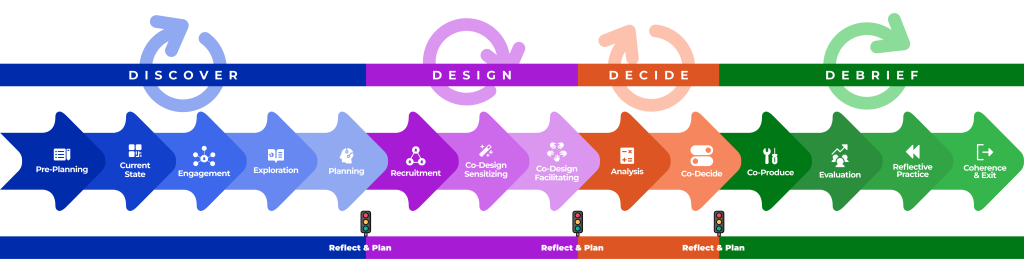
For those wanting a structured approach, the Co.Design4All framework offers a practical 4D methodology — Discover, Design, Decide, Debrief — supported by over 100 tools across fourteen stages. Used well, it converts the energy of a successful pitch into the structured, participatory work of designing a change that will actually survive contact with reality:
- Discover surfaces who is affected by the change and what they actually need — testing the assumptions that underpinned the pitch against on-the-ground reality.
- Design builds the solution with the people who will live inside it, not on behalf of them.
- Decide commits the group to a clear plan and a clear evaluation framework — the hip-pocket plank reappearing in operational form.
- Debrief reflects on what worked and what didn’t, so the next pitch, for the next change, is better than this one was.
Pitching and co-designing are not opposites. They are sequential disciplines. A well-structured pitch opens the door. Well-structured co-design makes the thing behind the door worth having.
Build the raft
Every change pitch is, at some level, an exercise in translation. The advocate has lived inside the idea for weeks or months. The audience meets it in a meeting room for forty minutes. Bridging that gap is the entire point of the head, heart, and hip pocket framework: give the audience the planks they need to build their own understanding, in the order they need them, at the pace they can absorb.
Head without heart feels cold. Heart without head feels naive. Either without hip pocket feels expensive. All three, in the right order for the audience in the room, is how good ideas become funded projects. And funded projects, if they’re built well in what comes next, is how the quiet slow-moving river of life actually changes course.
Build the raft. Cross the rapids. The other side is where the change happens.
References:
- Aristotle (2007). On Rhetoric: A Theory of Civic Discourse (G. A. Kennedy, Trans., 2nd ed.). Oxford: Oxford University Press. (Original work c. 4th century BCE.)
- Co.Design4All (2025). The 4D Framework: Discover, Design, Decide, Debrief. Available at: https://codesign4all.com
- Heath, C., & Heath, D. (2010). Switch: How to Change Things When Change Is Hard. New York: Crown Business.
- Kahneman, D. (2011). Thinking, Fast and Slow. New York: Farrar, Straus and Giroux.
- Kotter, J. P., & Cohen, D. S. (2002). The Heart of Change: Real-Life Stories of How People Change Their Organizations. Boston: Harvard Business School Press.
- McKercher, K. A. (2020). Beyond Sticky Notes: Co-design for Real — Mindsets, methods and movements. Sydney: Beyond Sticky Notes.
- Sinek, S. (2009). Start With Why: How Great Leaders Inspire Everyone to Take Action. New York: Portfolio/Penguin.